
SQL Console
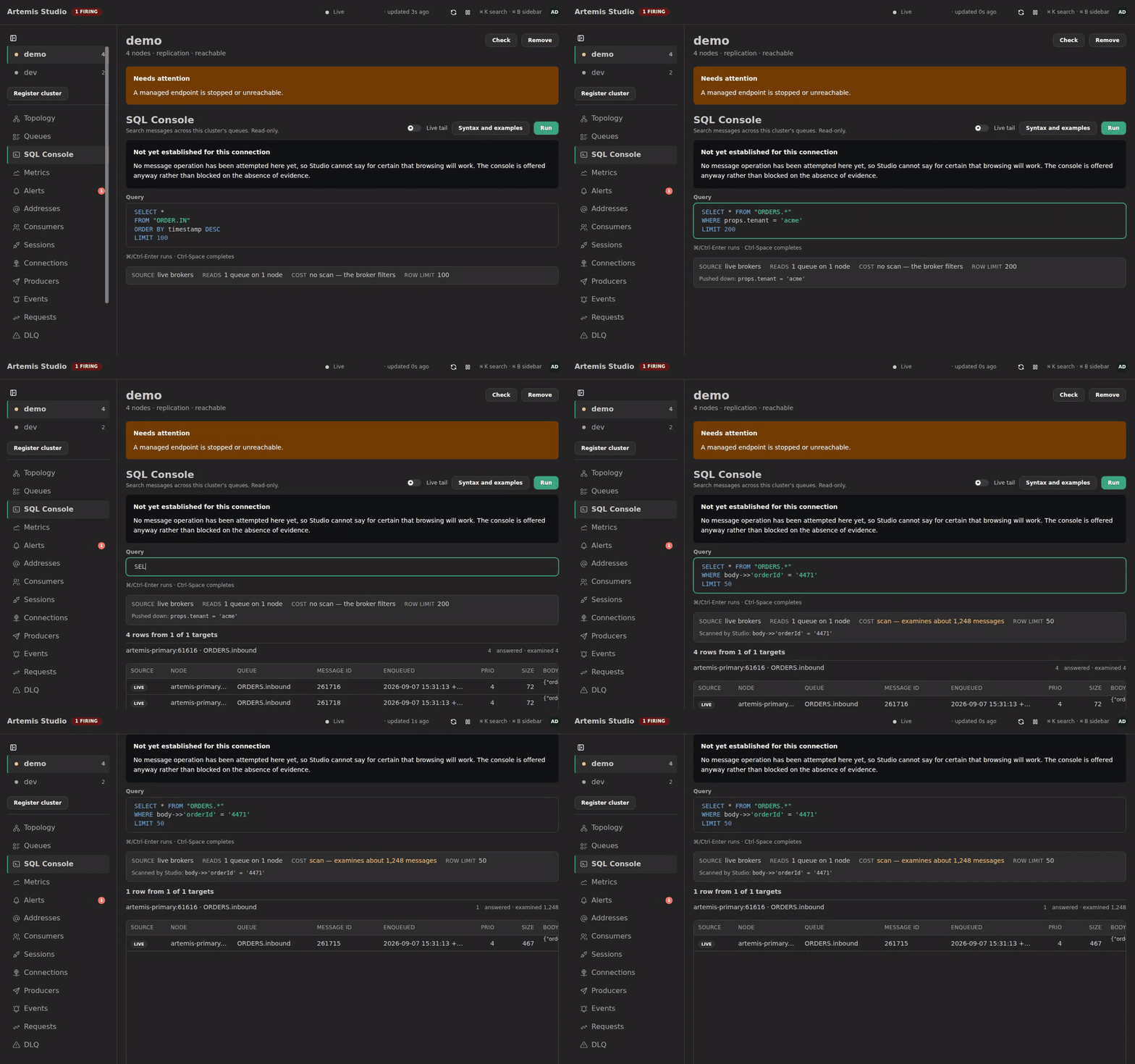
The question an operator actually arrives with is "where did order 4471 go?". Artemis cannot answer it. Its only server-side filter is a JMS selector, which sees message headers and application properties — not the body — and applies to one queue on one node at a time.
The SQL Console answers it, across every queue in the cluster, in one query.
SELECT * FROM "ORDER.*"
WHERE body->>'orderId' = '4471'
LIMIT 50
A real dialect, a small subset
SELECT only. One FROM. WHERE, ORDER BY, LIMIT. No join, no subquery, no union, no CTE — and no mutation is expressible at all.
It is real SQL syntax on purpose, so the editor's off-the-shelf grammar, highlighting and completion work unmodified. Queries are parsed to an AST and validated against a fixed column catalogue, node type by node type, rejecting by default. Nothing is validated by pattern-matching the query text; a regular expression asserting the absence of DROP is how this is usually got wrong.
Queue names are always double-quoted — ORDER.IN is a reserved word and a dot — and wildcards are Artemis', not SQL's: * matches one dot-delimited level, # matches many.
Where the query reads
The schema qualifier picks the backend, in the query text itself, so a query pasted into a ticket still says where it read from.
FROM broker."Q" | The live brokers. Current truth. |
FROM index."Q" | The historical index — still holds messages that have since been consumed, and only covers queues you subscribed. |
FROM "Q" | The index when every queue it names is captured on its node, the live brokers otherwise — a queue that is only sampled is read live. Capture does not backfill, so a message already on the queue when capture began is not in the index; the result says where the index begins. The plan says which it picked. |
What a predicate costs — before you run it
This is the part worth knowing. Every top-level AND conjunct is classified:
| Class | Meaning |
|---|---|
| Target | Chooses which queues are read. Costs nothing. |
| Pushdown | Becomes a JMS selector, so the broker filters and Studio never sees the non-matches. Costs nothing. |
| Scan | Studio examines every message the broker returned. |
Headers and application properties push down. The body never can — nothing but Studio can read it. The plan strip above the editor tells you which your query is before it runs, and over the configured cost ceiling the query is refused with the estimate, the ceiling and a hint for narrowing it. It is refused rather than truncated: a truncated result is indistinguishable from a complete one at a glance, and an operator mid-incident reads it as "not there".
One trap worth stating
A predicate that is free on its own stops being free inside an OR with a body predicate. Pushing down one side of an OR would narrow the set the other side gets to see — so a disjunction containing a scan is scanned as a whole. This is the one mistake in this area that produces a silently wrong answer rather than a slow one.
Columns
Selector-eligible (free): priority, durable, timestamp, expiration, size, jmsType, correlationId, groupId, userId, and any application property as props.<name>.
Target (free): queue, address, node.
Scan: body, messageId, messageType, replyTo, and — on the index only — observedAt, lastSeenAt, origin, origAddress and sourceMessageId.
Over the index, MATCH (body) AGAINST ('terms') is full-text search over stored bodies, served from a GIN index rather than scanned, and ORDER BY match_rank ranks by how well each row matched. Quoted phrases, -exclusion and or work as they do in a search box. Binary bodies are not full-text indexed, so a BytesMessage is never a match — use LIKE for those.
A JSON field inside the body is body->>'orderId'. The only functions the dialect accepts are now(), lower(), upper(), plus interval in a relative time. Relative time is normalised through each node's measured clock offset, so a broker with a skewed clock still answers correctly.
Worked examples
-- Cheapest possible: no predicate, the broker returns its head pages.
SELECT * FROM "ORDER.IN" ORDER BY timestamp DESC LIMIT 100;

-- Both predicates become a selector across a wildcard. Still free.
SELECT * FROM "ORDER.*" WHERE priority > 4 AND durable = true LIMIT 200;

-- Application properties are selector-eligible too.
SELECT * FROM "ORDER.IN" WHERE props.tenant = 'acme' LIMIT 200;

-- A scan. Narrow it with a header predicate first.
SELECT * FROM "ORDER.IN" WHERE body LIKE '%4471%' LIMIT 50;

-- Full-text over stored bodies, ranked. Index only.
SELECT * FROM index."ORDER.*"
WHERE MATCH (body) AGAINST ('"order 4471" -cancelled')
ORDER BY match_rank DESC LIMIT 50;

-- A time window, quantized and skew-corrected.
SELECT * FROM "ORDER.*"
WHERE timestamp > now() - interval '2 hours'
ORDER BY timestamp DESC LIMIT 500;
The optional index
The message index is opt-in per queue, retention-bounded, and disposable. It exists so a question can be asked about a message that has already been consumed — which the brokers, correctly, no longer know anything about. It is treated as retained payload for the purposes of access control and deletion, and dropping it costs history, never truth.
It fills in one of two ways, and they make different claims:
| Mode | What a row means |
|---|---|
| Sampled | A poll of this queue saw this message. A message that arrived and was consumed between two polls was never recorded. |
| Captured | The address routed this message. Whether anything consumed it in between makes no difference. |
Capture changes routing on your brokers, so it is a deliberate act with its own permission and its own page: Message capture.
The live tail
The tail is a poll, never a consume. It cannot mutate anything and it does not compete with your consumers. It says so permanently in the UI, because a sampled tail that reads as a complete capture is a way to conclude a message was never sent.
A tail over captured queues makes the stronger claim, and says a different thing: every message the address routed appears, whether or not it was consumed immediately. The two are never worded the same way — one node without a tap and it is a sampled tail again, with the gap named.
Acting on a result
You cannot. Deliberately. Acting on a result row routes back through the ordinary message operations, which already carry the dry run, the bulk cap and the audit record — a second path to a destructive verb would be a second place to get the safety contract wrong.