
What Artemis Studio is
Apache ActiveMQ Artemis ships with a console that manages one broker at a time and has no idea a cluster exists. That is fine until the question you have spans nodes — which it always does, because the interesting questions are "which node is live", "where is the depth", and "where did that message go".
Artemis Studio is the other thing: one instance across many clusters, with the cluster as the unit of everything.
It works against your existing brokers. There is no broker.xml rewrite beyond enabling the management endpoints you almost certainly already run, and nothing here starts a broker.
What it does
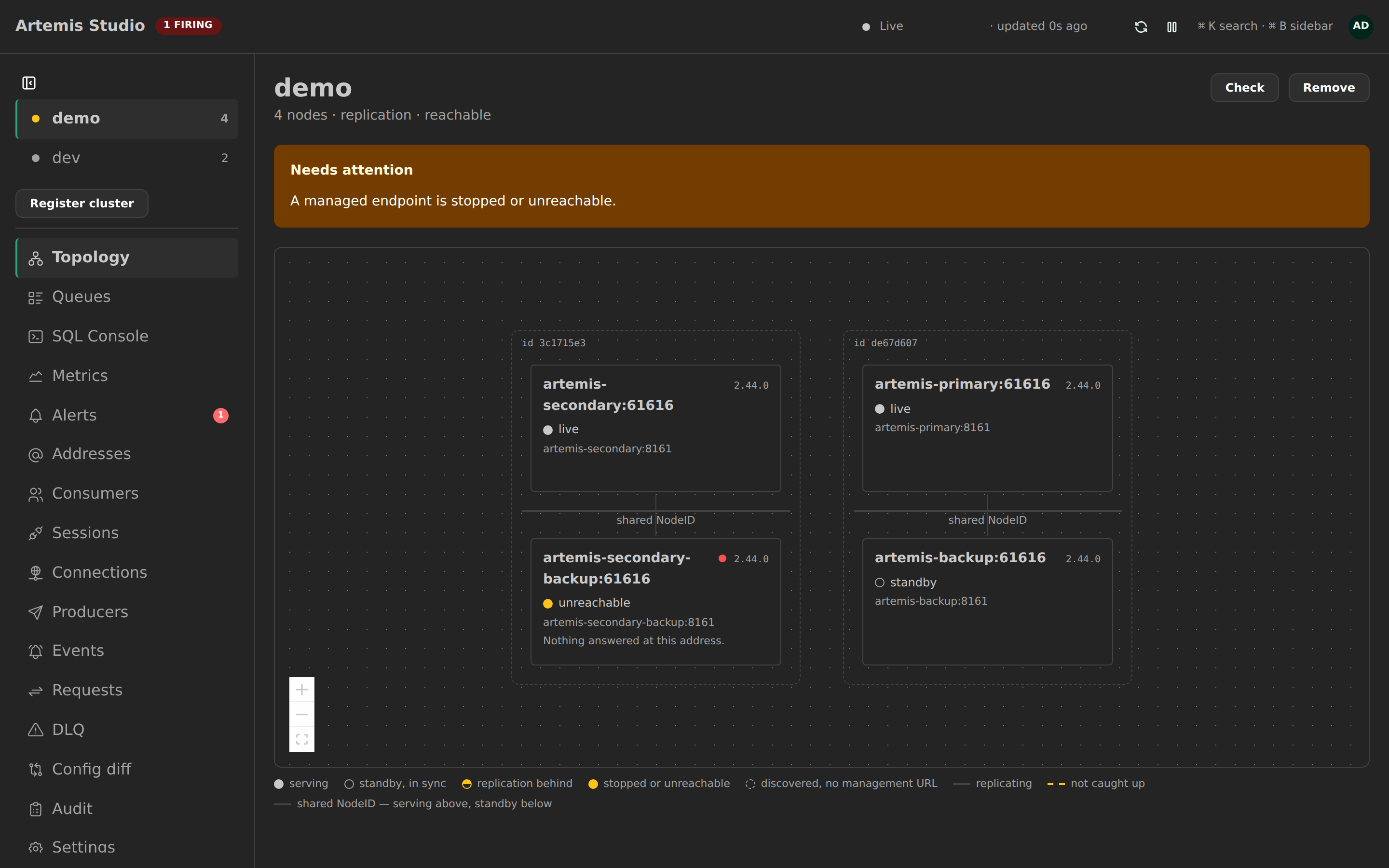
| Topology | Live/backup pairs, replication state, shared-NodeID grouping, on one canvas. HA role is polled from every node on every cycle — never inferred from configuration. Two live in a pair is a critical split-brain alert. |
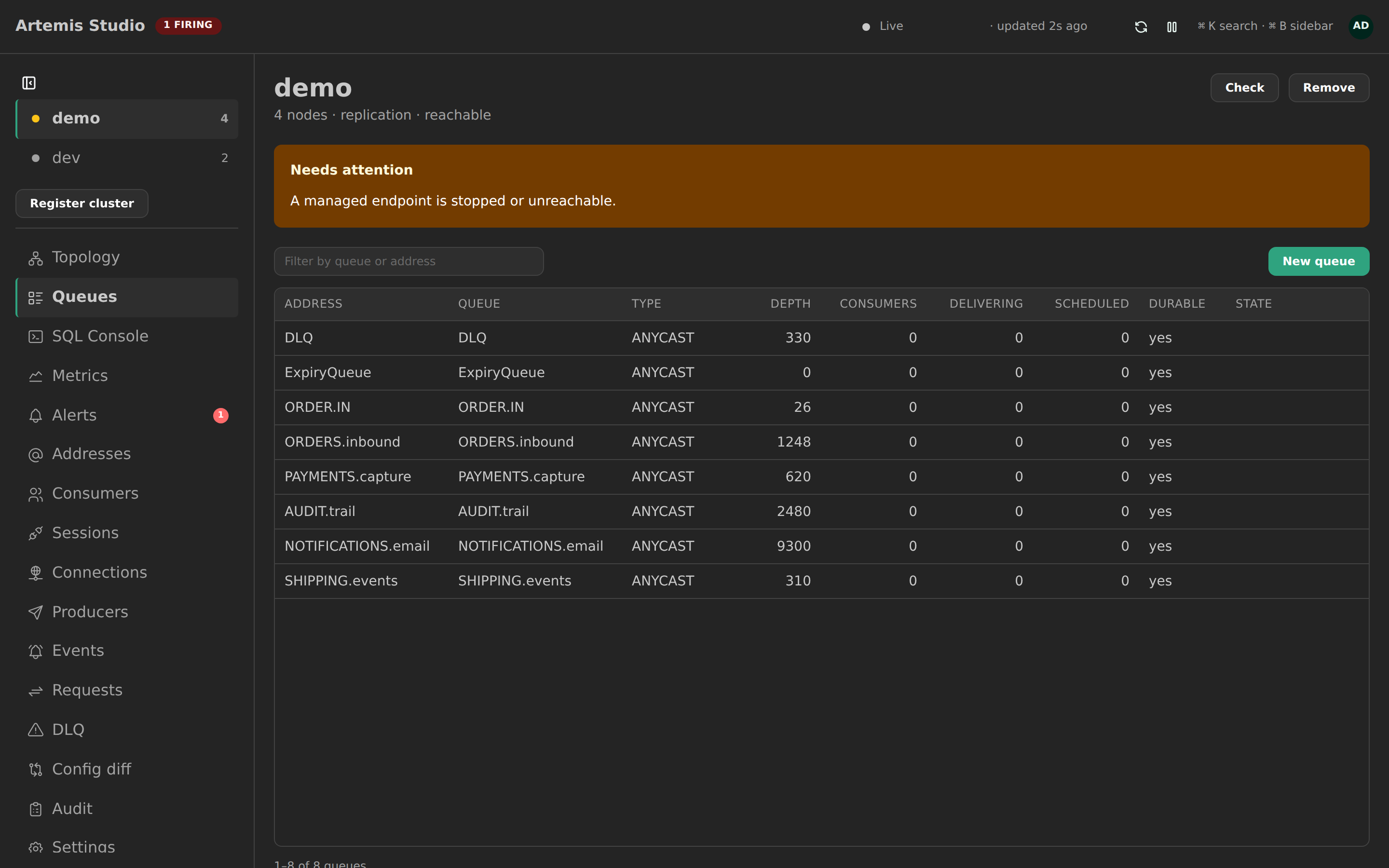
| Cross-node resources | Queues, addresses, consumers, sessions, connections and producers across every node in one virtualised table, attributed per node, updating over SSE. |
| Message operations | Browse, send, move, retry, expire, delete, purge — with a dry run that answers with the affected count without acting, a server-enforced bulk cap, and per-node outcome reporting. |
| SQL Console | A restricted read-only SQL dialect over the messages in a cluster, including the body, with an optional retention-bounded index and a live tail. |
| Request-reply tracing | Requests correlated to their replies across addresses and nodes, with latency and timeout statistics against expectations you declare. |
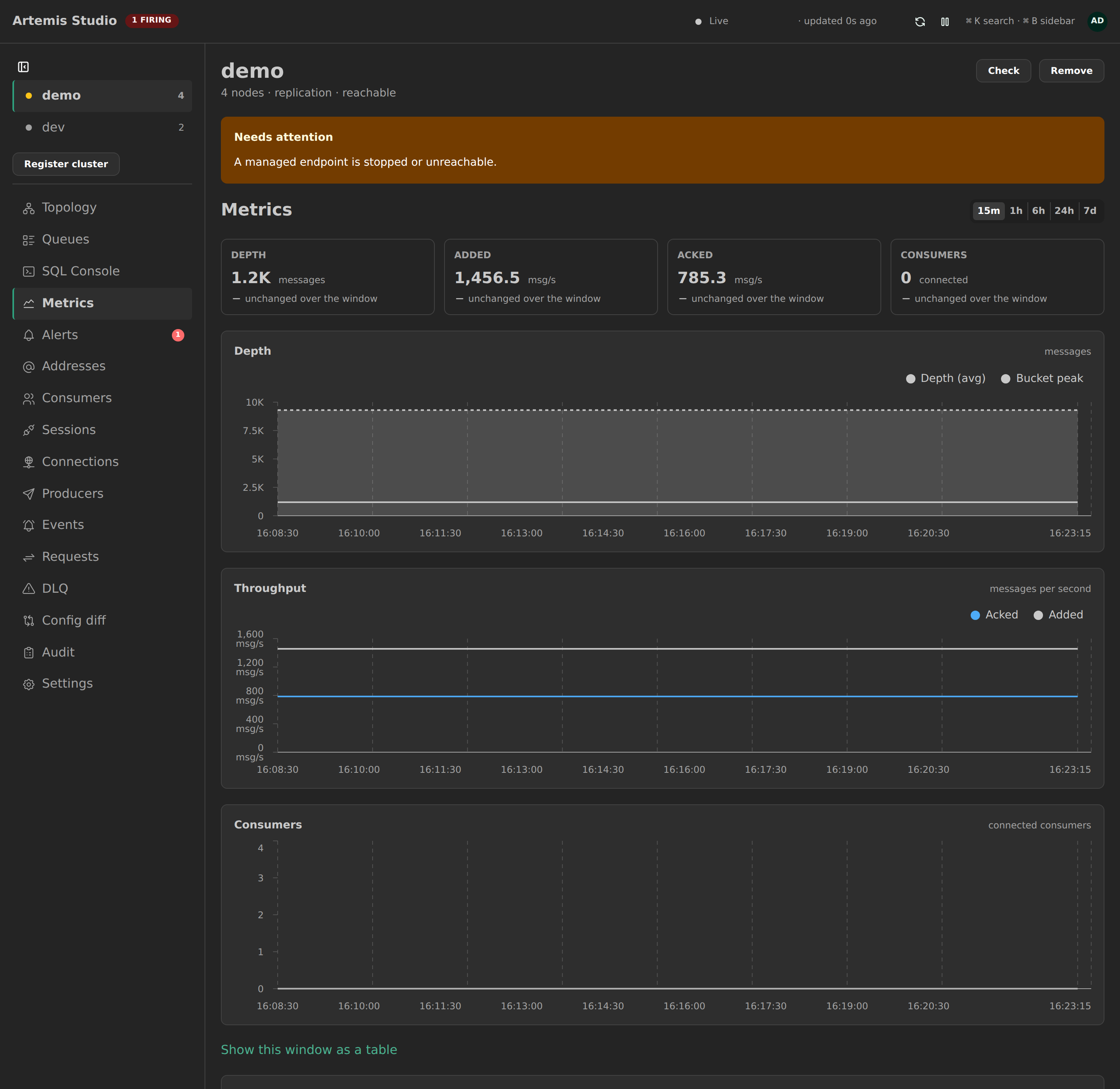
| Metrics and alerting | Depth, throughput and consumer series in partitioned Postgres, with charts and rules that fire on what they measure. |
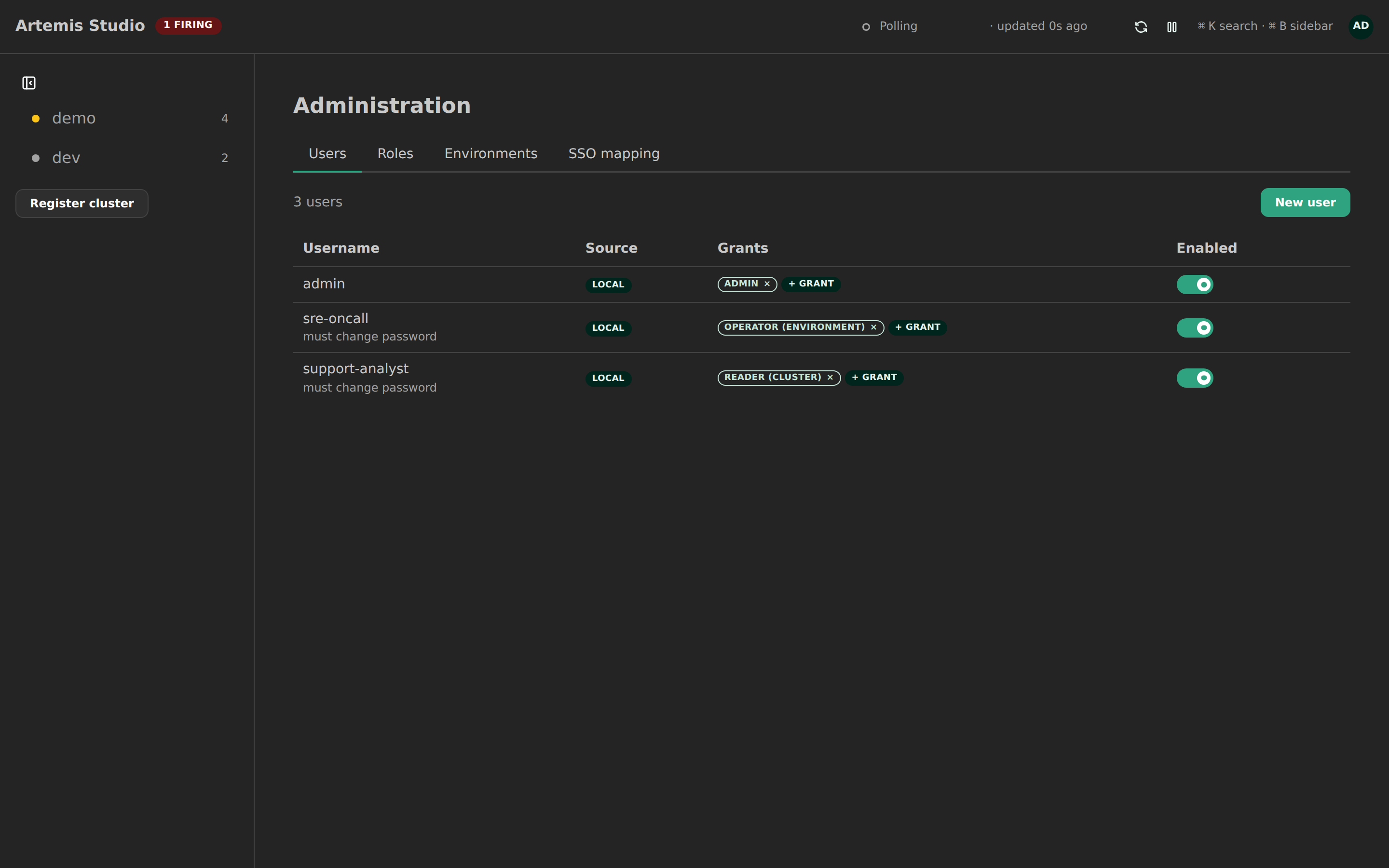
| Governance | Authentication on every endpoint, a dynamic role/permission model scoped global → environment → cluster, API tokens, optional OIDC/SSO, and an audit event for every mutating call. |
| MCP server | The same capabilities exposed to an assistant, under the same grants and the same audit trail. |
Four rules it is built on
These are not aspirations; they are constraints the code is held to.
Broker-friendly by construction. Reads are batched — one Jolokia POST per node, never one per queue — and tiered by how fast a thing actually changes, behind a per-node rate limiter. Studio must never be the reason a broker falls over.
Safe by default. Every destructive operation takes ?dryRun=true and returns the affected count without acting. Purge and delete require the resource's own name typed into the confirmation. The audit event is written in the same transaction as the command, before the broker call, and updated with the outcome — so a crash mid-operation leaves a record that it was attempted.
Never trust config for HA state. Who is live is a question for the live nodes, asked on every poll.
Honest capability gating. When a feature is unavailable because the connection lacks a capability, the UI says so and shows the exact broker.xml snippet that would enable it. Nothing is silently missing, and a capability that has not been established yet leaves the control enabled with the uncertainty stated — an absence of evidence is not evidence of absence.
What it deliberately is not
- Not a broker installer or configurer. It manages brokers you run.
- Not a message-queue client. The SQL Console is
SELECT-only and the live tail is a poll, never a consume; neither can mutate anything. - Not JMX. Jolokia HTTP is the primary transport, with the Artemis Core client as the second channel for notifications and faithful message I/O.
Screenshots
| Cluster topology | Cross-node queues |
|---|---|
 |  |
| Metrics and charts | Governance |
 |  |
Next
- Quickstart — running in about a minute
- Configuration — the environment it needs
- Architecture and the decision records